> For the complete documentation index, see [llms.txt](https://help.sipgate.de/llms.txt). Markdown versions of documentation pages are available by appending `.md` to page URLs; this page is available as [Markdown](https://help.sipgate.de/ai-agents/en/post-processing/e-mail-summaries.md).
# Email Summaries
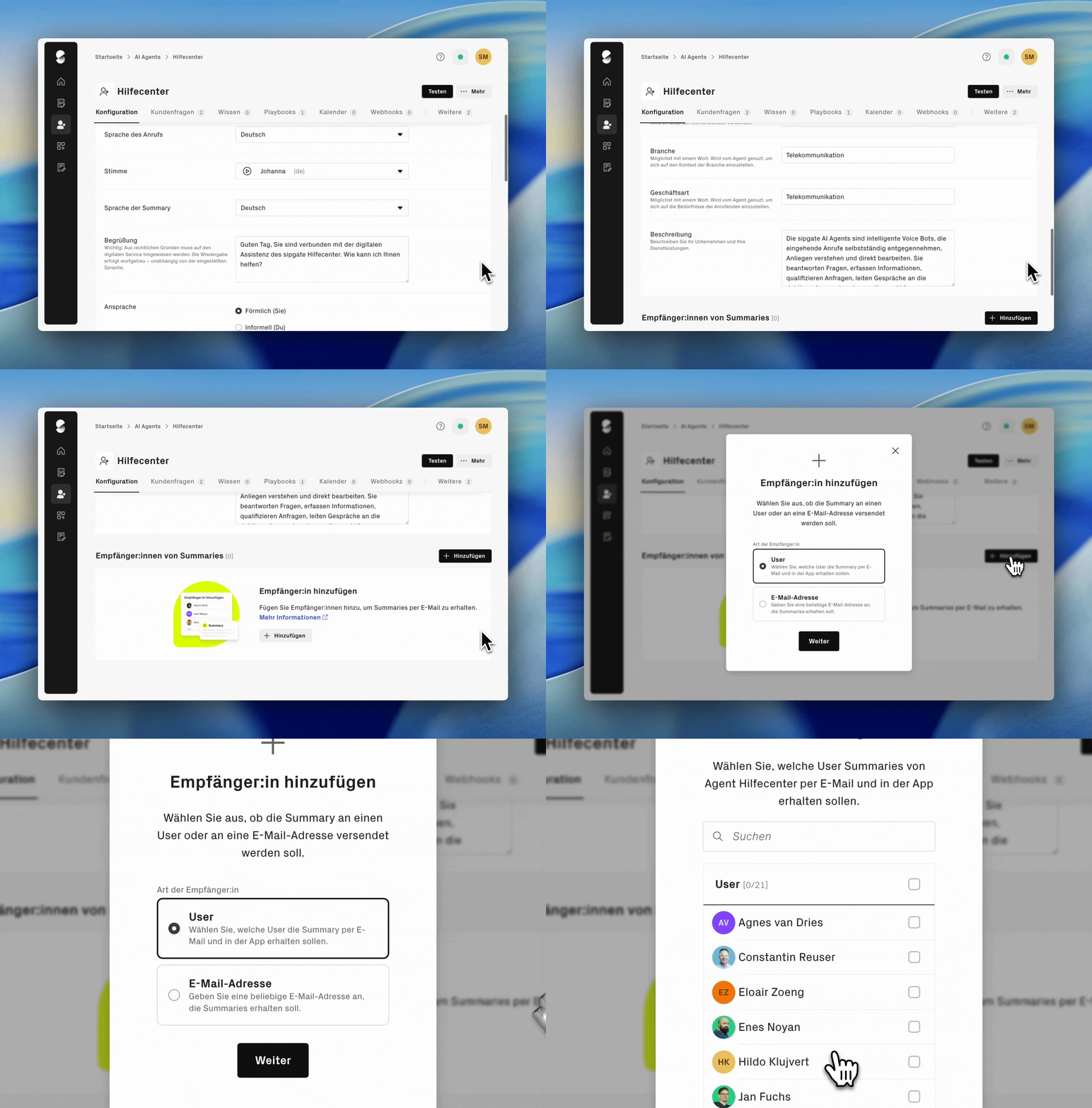
After every conversation, your AI Agent can **automatically send a summary - that is, a summary, by email.** That way, you stay up to date without having to log in separately and can pass information on specifically to teams or external parties.
### **Define recipients**
Go to **AI Agents → Select agent → Configuration** and scroll all the way down to **Summary recipients**. There you can add and edit as many email addresses as you like.
### **What is in the email?**
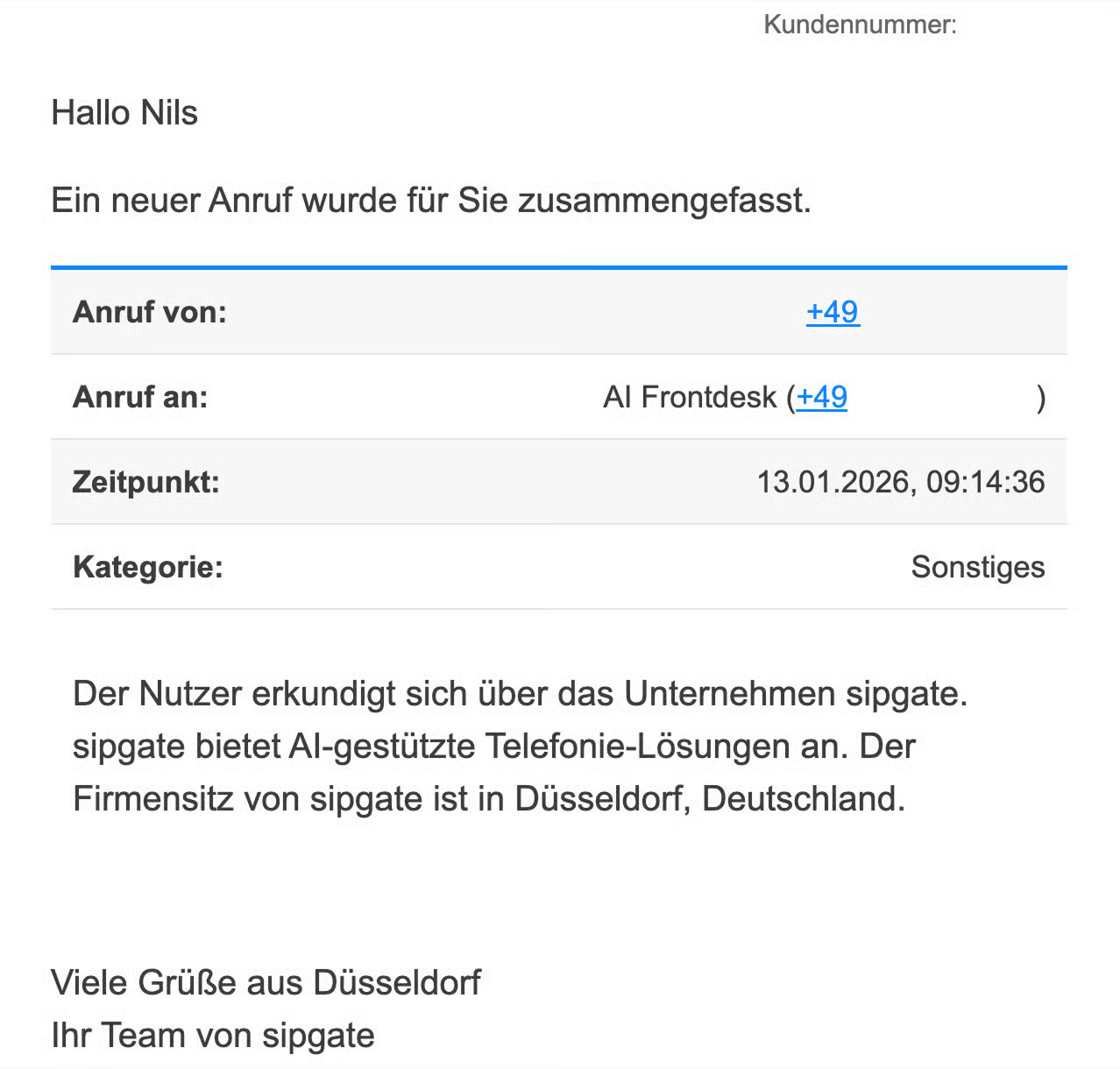
**Each summary contains:**
* Caller’s phone number
* Agent’s phone number
* Time and duration of the conversation
* Category
* Summary of the conversation content
{% hint style="info" %}
**Note:** In [**Playbooks**](/ai-agents/en/behavior/playbooks.md) you can tick the "Summary" box for each task. Only the marked tasks will then appear in the email summary; all other recorded information is omitted.
{% endhint %}
### **What is this useful for?**
Email summaries are especially useful when several people or teams need to be informed about calls - for example in customer service, sales, or appointment coordination. This gives everyone involved direct access to relevant information without having to use the sipgate app themselves.
{% hint style="info" %}
**Note:** You can find the complete call logs with transcript and note function in the sipgate app. More on this in the article [**Summaries & Transcripts**](/ai-agents/en/post-processing/summaries-and-transcripts.md).
{% endhint %}
---
# Agent Instructions
This documentation is published with GitBook. GitBook is the documentation platform designed so that both humans and AI agents can read, navigate, and reason over technical content effectively. Learn more at gitbook.com.
## Querying This Documentation
If you need additional information that is not directly available in this page, you can query the documentation dynamically by asking a question.
Perform an HTTP GET request on the current page URL with the `ask` query parameter, and the optional `goal` query parameter:
```
GET https://help.sipgate.de/ai-agents/en/post-processing/e-mail-summaries.md?ask=&goal=
```
`ask` is the immediate question: it should be specific, self-contained, and written in natural language.
`goal` is optional and describes the broader end goal you are ultimately trying to accomplish on behalf of the user. GitBook uses it to tailor the answer towards what is most useful for that goal.
The response will contain a direct answer to the question and relevant excerpts and sources from the documentation.
Use this mechanism when the answer is not explicitly present in the current page, you need clarification or additional context, or you want to retrieve related documentation sections.